Showing posts with label graphic novels. Show all posts

Friday, 26 September 2014

Comic Conversation

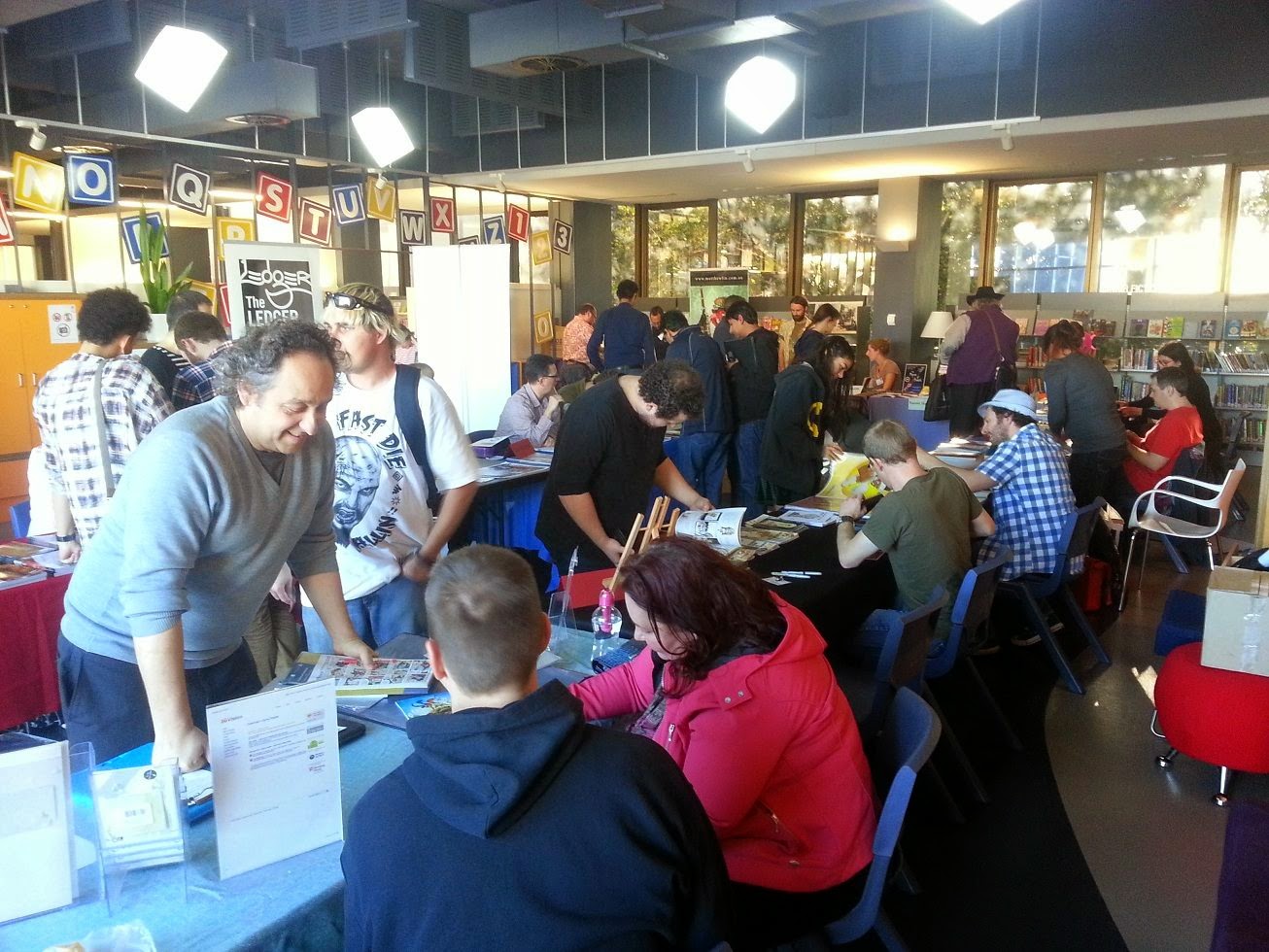
Comic Conversations. Photo by Kings Comics.
On Saturday September 20th I had the extreme pleasure of attending Comic Conversation, an event at Ashfield Library celebrating comics and graphic novels, just one week after Sydney Comic Con. It featured workshops and panel discussions, exhibitors and entertainment,  live sketching and portfolio reviews. In a week when Nielsen Bookscan reported a 10% year on year growth in graphic novels from 2013-2014 in the US it was a revelation to me how vibrant our local comic scene is, in both creation and consumption of this format.


According to the Panel Session "Meet the Sydney Comics" Sydney has the most receptive and committed fan base for comics in Australia. The community is strong, and the digital connections across the globe are making it a reality for local creators to showcase their work to a global audience and work from Sydney or anywhere. Publishing on the web can help a budding creator to access their niche from a global audience, to grow in confidence and build technical skill, and maybe to move their work from a hobby to the next level. Comic artists working in Sydney are producing work for the big studios as well as their own independent publications. The Ledger Awards for comics in Australia have restarted after a hiatus, further supporting local creators. Australian based comic artists are getting in on the film/TV action as well. A comic created by Australian Tom Taylor, The Deep, is being turned into a 26 part CGI animation series for children by a French company.


Panel Discussion. Photo by Kings Comics.
There has been a huge rise in interest in comics and graphic novels in the last five years. Changes in the availability of digital printing has meant that self publishing is not the financial drain for creators that it once was when print runs of 10,000 had to be placed in newsagents. Companies like Comixology are delivering comics at a price that makes comics much more competitive with prose works. In the past, consumers have baulked at paying the same price for a prose work that might take a few days to read as a comic that might take an hour - hard to deal with for creators as their writing/drawing time is equivalent to prose authors.

In the Panel Discussion "All Comics Great and Small" the panel also made the point that the literacy level of readers in this visual medium has also developed. Just like in any other form of expression, experiencing the classics develops literacy. Literacy turns into fluency. Chewie Chan commented that comics are more accessible, not because they are simpler, but because we are so well versed in visual language. This visual literacy can also be seen in other media such as the growth of infographics for data visualisation.


Workshop. Photo by Kings Comics.

One future area of growth for the comic format is non-fiction works. The panel discussed the work being done, for example, in medical comics which explain medical conditions for patients, and others which educate doctors about their patient interactions. A conference is held each year at Johns Hopkins Medical Campus in Baltimore on this topic. There are plenty of other non-fiction works. The panel specifically mentioned Scott McClouds's Understanding Comics:The Invisible Art and Larry Gonick's Cartoon History of the Universe (and the other books in that series) as examples of how powerful comics can be in non-fiction/education. Schools for comics in Malmo, Sweden and upstate New York, USA, were noted as incubators for innovation and imagination, producing work that was admired by panellists.

"In a perfect graphic novel the prose and the drawing hold equal weight," says Chewie Chan. Learning this was the key change in my own enjoyment of comics. Being a reader of prose, I was reading through graphic novels in the same way, until I read an article about details hidden in one of the books I had been reading. I went back to find all these easter eggs and realised that I was really missing a big chunk of the story by racing through the drawings, and not giving them proper consideration. This is echoed too in the collaborations that develop between writers and illustrators to develop comics, as some start as storytellers, and have to develop drawing skills or vice versa.  Some comics are the work of an individual, but many are the work of teams, each contributing their strengths. Also, the panel noted that in this format, the reader actually does a lot of the work, almost to the point of being a co-creator. Because the story moves from panel to panel, the reader has to fill in the "gutter" between the images with their own contribution.


Graphic Novels. Photo by Kings Comics.
What of comics and graphics novels in libraries? One panellist commented "I wish all libraries would stock my graphic novel." It's not viewed as a lost opportunity for a sale but rather as an opportunity to bring a new reader to this format. There does exist a challenge of getting books into libraries because they are often published independently, and lack the backing of a big publishing house that can facilitate the acquisition process. But if you want to know more, perhaps you could contact the Collection Management Team Leader at Ashfield Library, as Ashfield certainly does have an enviable graphic novel collection, which includes many Australian works. 
Thanks to them for running this event, I really hope it becomes an annual fixture.


Want to find out more about comics and graphic novels?

Kings Comics in Sydney has a You Tube channel, featuring the Kapow Comic Book Show

Geek Actually has a comics podcast Behind The Panels

Panels is a Book Riot spin off on Facebook, although not local, very interesting.

Take a look at Comics For a Cause where you can donate old comics to adult and teen literacy schemes and ESL centres.

Comics on Halloween coming up soon at Liverpool Library


-Lauren Castan

Thursday, 20 June 2013

Graphic Novels


Graphic novels have carved out a place in libraries in recent years.  With an increasingly wide spread of  genre, theme, and intended audience they are reaching more and more readers, but they do require a different reading technique.

Last year I attended a Book Club session at my local library, attracted by the topic “Graphic Novels”. I’m a keen but uneducated reader of this format and hoped to share some of my favourites and collect some suggestions for future exploration. The members of this group meet during the day in the Sydney suburbs and it’s probably no surprise that most members of the group were women, possibly with adult children of their own. They had not chosen the topic for the group, but each selected an item from the collection with no guidance and took it home to read and report back. The responses were mostly pretty negative. Some had trouble following the sequence of the panels at times. The selections had not been well made and didn’t suit the readers at all. The librarian with the special interest in graphics who was to lead the group wasn’t rostered on for the day of the meeting. Although I think the members didn’t mind stepping out and trying something new, they just put that month down to experience and had a laugh.

Because the pictures take the place of the bulk of the descriptive writing, the reader really does need to take time to consider each panel, and panels in relation to each other.  Pace can be slowed by panels with no text, and repetition of similar images provide links to different scenes. I still find emotions can be fully conveyed to the reader. I cried in Full Metal Alchemist  Volume 2 when the talking dog spoke to Edward and Alphonse, revealing the full horror of its creation just like I did at the end of The Book Thief (a title with some interesting graphic additions).

Graphic novels have taken time to settle in at libraries. There has been a fair bit of back and forth about cataloguing, especially where there can be so many contributors to the finished product.  Shelving can also be a bit polarising, but in most cases libraries seem to have settled on a separate section rather than interfiling. Adult content needs careful evaluation and management. All the styles in this format can be confusing – manga especially. I find it very irritating to discover something like In Odd We Trust has been shelved in with the manga simply because they are both printed in the same size paperback format, but I do appreciate the niceties aren’t obvious to everyone. I also am annoyed that I am unable to easily find everything in, say, Batman, as it isn’t shelved together because the different creative teams cause them all to have different call numbers, some end up with the title, some with the illustrator or whatever.  I’ve seen the volumes from the same series with three different call stickers, one for the illustrator, and one each for the two authors. Here is a link to a paper presented at ALIA 2004 which has lots of good information, still relevant.

At the Hallowed Ground Future of the Book event last year, Australian illustrator Queenie Chan made a point that graphics can sometimes be a hard sell. Creators of both these types of work might spend the same amountof time working on them, but don’t see the same return. People don’t want to pay the same for this format which can be read in an hour as they would for a text work that might be enjoyed over a week.  Reflecting on my own habits, I would say she is right on the money.  I get nearly all my graphic novels from libraries and keenly watch .

The link between graphic novels and comics and film is no news, and neither is a graphic version of a well known novel, but it can be intriguing to compare the different versions. I’m really excited for the film release of Ender’s Game later this year (trailer here). I read the series two or three years ago, and last year read the graphic treatment of the first novel in the series, on which the film is based. It was interesting because it presented the story from the perspective of another character. Maybe something like this could be a starting point for your own reading. Or perhaps an author that works in both media like Neil Gaiman  or Mike Carey? I also really enjoyed Snow Crash by Neil Stephenson, a prose novel that began life as a graphic novel. In graphics, I read genres like horror,  in which I wouldn't normally have much interest. I love Locke and Key and wish that the much talked about pilot had been turned into a tv series, and am sad the series is set to end at volume 7.

I’d love to attend a library event for adult readers of graphic novels and manga. Until then, I’m waiting until my son is old enough so I can legitimately attend some of those teen manga workshops.


Lauren Castan