Showing posts with label public libraries. Show all posts

Friday, 20 November 2015

Four libraries of Ireland and what they can teach us…


It’s no surprise that a country home to literary greats like Oscar Wilde and James Joyce should have some amazing libraries. I’ve just returned from a trip to the library land of Ireland having chronicled a list of my favourite Irish libraries and what they can teach us here in Australia.


The old Library, Trinity College

The Old Library at Trinity College features consistently on lists of the greatest libraries in the world. This is because it is enchanting. The Old Library has a hushed reverence that draws thousands to its quiet halls, wandering among the rows and rows of antiquated tomes.


The Old Library can teach us two things. Firstly, it is a legal deposit library and it highlights the importance of keeping legal deposit books in an archive for future generations to enjoy. Secondly, the Old Library is living evidence that people still love libraries and still love books on shelves. The day I visited lines of people stood waiting in the rain just to catch a glimpse of its Book of Kells, an illuminated manuscript of the four Gospels thought to have been created in c. 800. In the halls of the Old Library cameras and iPhones snapped away but even amid modern technology this library with its shelves and shelves of books remains timeless.


Marsh's Library

Marsh’s Library is the oldest public library in Ireland. This library taught me the value of unexpected libraries and that meaning can be found in things we might think are irrelevant or foolish. Marsh’s Library is like something from a Halloween story with shelves full of heavy tomes and creaking floorboards. But here I found a library embracing the present as much as the past. The library even has its own Facebook page!


When I visited Marsh’s Library they were holding an exhibition of marginalia, sketches and notes written in the library books that readers have added over time. Titled The Unicorn and the Fencing Mouse, after a sketch depicting both, this exhibition featured annotations made by hand in medical texts and other volumes. I loved the quirky, unexpected nature of this exhibition. It gave meaning to what might otherwise be considered trivial notations, even graffiti.


Chester Beatty Library
The Chester Beatty Library is part of Dublin Castle and houses religious and secular manuscripts dating from 2700 BC. This library also awakened me to the role humour can play in libraries. One of their many exhibitions was titled “Wicked Wit” and depicted the use of political cartoons in documenting relations between Ireland and Britain. This collection of cartoons reminded me of the potential for libraries to key into historical humour in their exhibitions. Our exhibitions can be entertaining and light-hearted as well as informative.


Another lesson I learnt from the Chester Beatty Library is how libraries can be embracing of all religions. In the exhibition galleries excerpts from the Quran went hand in hand with exhibitions about Christianity, proving that libraries truly are pluralistic institutions.

The National Library of Ireland

The National Library of Ireland taught me the value of genealogy as a way for people to piece together narratives of the past. The Library has featured internationally as a recommended tourist destination for genealogists. This is because of the rich and varied history it preserves, including the Library’s unique set of Catholic parish registers. The National Library of Ireland also has a significant manuscripts collection which includes such gems as letters of Oscar Wilde and the papers of Irish poet, W. B. Yeats.


Visiting the Genealogy Advisory Service in this library impressed upon me how family history research is intrinsically tied to our social histories so that a name on a census can tell you about gender relations or economic status. It reminded me of the social and historical importance of the detailed family histories our clients are compiling in libraries every day.


Anne Reddacliff @AMoodiLibrarian

Event Officer, ALIA Sydney


Saturday, 20 June 2015

Blog Ever Day in June day 20: The Importance of Libraries in Bridging the Digital Divide by Yasmin Cole

Today's post comes from Yasmin Cole, who works as a Librarian at the City of Ballarat Library Services.

As new technologies are developed and increasing amounts of information and common tasks are moved online, Australian Libraries play an important role in equipping Australians to use these technologies. In 2012-2013, the Australian Bureau of Statistics reported that only 58% of Australian households with an annual income of $40,000 or less, had a home internet connection, as opposed to 98% of households with an annual income of more than $120,000 (ABS, 2014b, para 2).

 Moreover, Digital literacy and e-skills: participation in the digital economy lists seven groups at risk of facing a digital divide due to low digital literacy, including Australians on a low income; Australians who have not undertaken higher education; senior Australians, rural Australians, Indigenous Australians, Australians with a disability and Australians from a non-English speaking background (Innovation and Business Skills Australia, 2013, p3). This gap between the technology ‘haves’ and ‘have-nots’ is known as the digital divide and has sparked fears that new technologies will replicate existing socio-economic chasms (Wallis, 2007, pp. 261-262).


Many common tasks and forms are now only available online, such as job applications, receiving utility bills, entering competitions, Australian Passport renewals, Working with Children’s Checks, Police Checks, Tax File Number applications and e-Tax. Additionally, various government departments, for example, Centrelink and Medicare, promote the use of their online services to avoid lengthy queues. Whilst this benefits those Australians with access to reliable internet service, it disadvantages those Australians who are most likely to need to access to these services, such as low income Australians, seniors and the unemployed.


Public libraries have long prided themselves as being at the forefront of equal access to information ("Libraries building communities: report one: Setting the scene," 2005, p. 17). As society has progressed to include digital technologies, this community service has become even more crucial. The Internet and PC usage in Victorian public libraries: summary report, suggests that Libraries are uniquely placed to assist their communities, by providing free access to computers and the internet, as without this service, there is a chance these citizens would face disenfranchisement from society (I & J Management Services, 2012, p. 1).

Reference List
Australian Bureau of Statistics. (2014b). Household use of information technology, Australia, 2012-13: household internet access. Retrieved 9/8/2014, from AusStats Database http://www.abs.gov.au/ausstats/abs@.nsf/Lookup/8146.0Chapter12012-13
I & J Management Services. (2012). Internet and PC usage in Victorian public libraries: summary report. Retrieved 22/9/2014, from http://www.plvn.net.au/sites/default/files/InternetPCUsage_SUMMARY.pdf

Innovation and Business Skills Australia. (2013). Digital literacy and e-skills: participation in the digital economy: executive summary. Australian Government Retrieved from https://www.ibsa.org.au/sites/default/files/media/Digital%20Literacy%20and%20E-skills.pdf.
Libraries building communities: report one: Setting the scene. (2005). Retrieved 4/9/2014, from http://www2.slv.vic.gov.au/pdfs/aboutus/publications/lbc_report1.pdf

Wallis, J. (2007). The social, political and cultural context of libraries in the twenty-first century: an overview Libraries in the twenty-first century: Charting new directions in information services (pp. 257-266). Wagga Wagga, Australia: Centre for Information Studies.


Thursday, 14 May 2015

Learning to See

On the weekend I was coaching a teenage friend of mine in learning to become a netball umpire. Among other pieces of advice I shared, I reminded her that when you are an umpire you look at the game in a whole different way. You are not a player, you are not a spectator. You are looking for different things, and your experience of the game is quite different. Later I reflected that this is quite similar to experiencing libraries, depending on what you are doing there.

As a library user, I am assessing libraries in quite a different way than I do when I am working there, or when I am touring a library as part of a professional development visit. This is one reason it's so valuable to visit, use, or tour other libraries.

I recently started working in a public library. Once I knew I had secured an interview for the position, I looked at the web presence of the library and took myself in for a look around, seeing it as a user. In my mind I was comparing the physical space, the collections, and services to other libraries of which I am a member. Later I thought about it more in the way I would if I was touring a library as part of a professional visit. You can't really see the problems or challenges clearly, and this is part of the way we all present our workplace to peers, but you can appraise things that are working well and assess them to see if that success is translatable to your own workplace. Then, on a quieter moment I was talking to a long standing staff member who told me about plans to renovate the library and change the floor plan around, and pointed out parts of the library that needed renewal. Until then I had been blind to those faults, so this gave me a different perspective.

It's a natural progression when you are new to a workplace to take all these different views. But it's pretty hard to generate a new perspective of your own workplace when you've been there for a while, to put yourself in the shoes of the other. It's conversely easy to discount the familiar as being boring or underwhelming, to look and see only the problems or frustrations or the things that could have been, if only. This view is also valuable, because it's only through dissatisfaction with the status quo that advancements are made. In the book "Against Happiness: In Praise of Melancholy" by Eric G Wilson, the Publishers Weekly review mentions that the author "argues forcefully that melancholia is a necessary ingredient of any culture that wishes to be innovative or inventive." The work concentrates especially on art, but I think it's true of many things. However, a constructively critical eye needs a balance, and to be able to assess both the parts and the whole, to recognise the ideal and work with the possible.

So I encourage you to continue to seek out new ideas, share successes and failures, and store these ideas and insights safely, even if they are not relevant to your situation now or don't even seem remotely possible under current realities of budgets and permissions and competing needs. You never know how a different perspective may work it self out in the future.

Lauren Castan


Saturday, 25 April 2015

A visit to Cagayan de Oro City Library


Recently, I went to Cagayan de Oro in the Philippines to visit family over Easter, and I was lucky enough to spend some time in the local public library. As a recent graduate in both information studies and international studies, I have a special interest in the differences and similarities in library services between Australia and other countries. I was eager to use part of my trip to explore all the libraries in the local area, though due to a strict dress code (no shorts or short-sleeved t-shirts allowed!) I was unable to visit the adjacent Xavier University Library in addition to the public one.


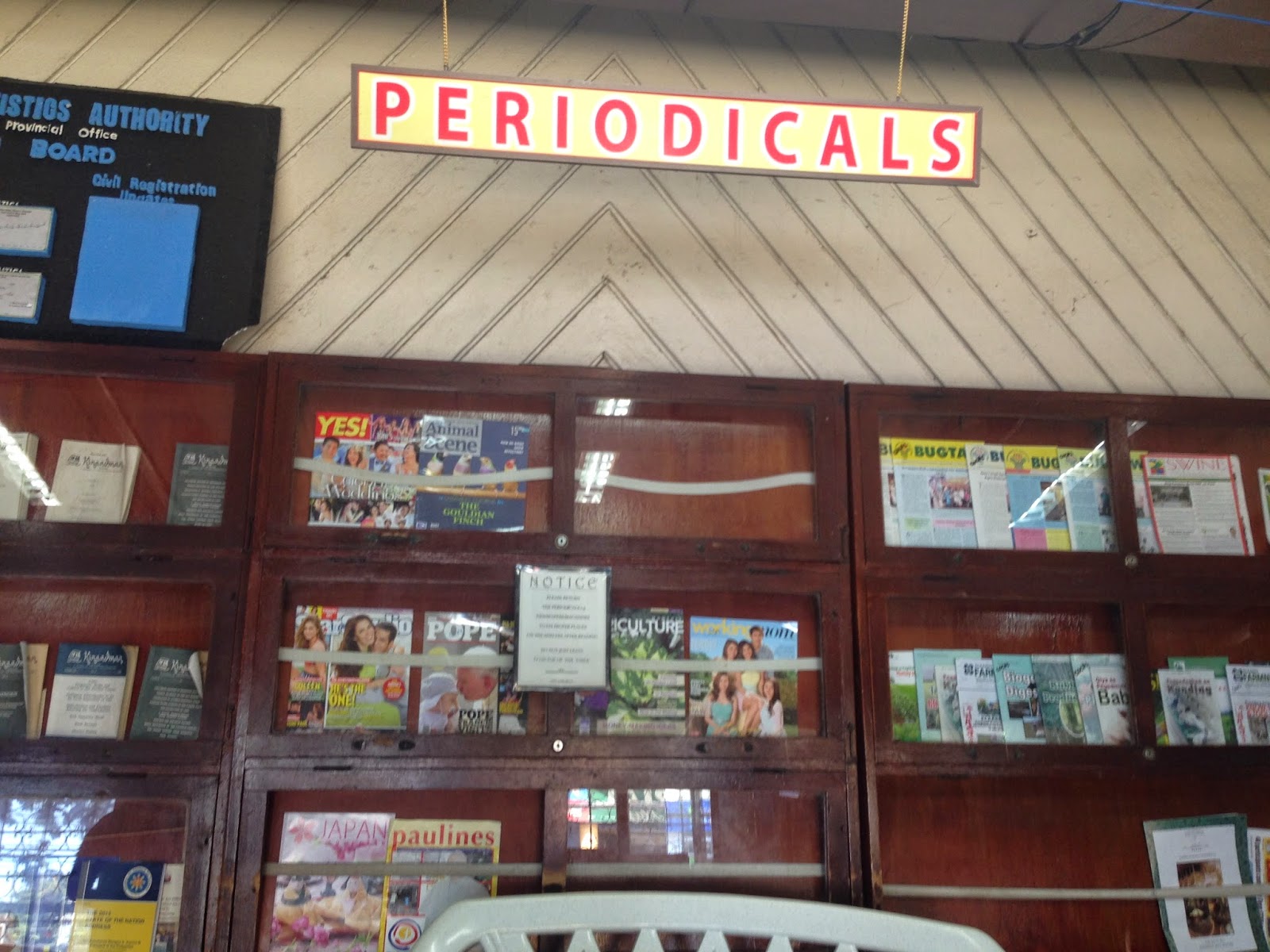
Cagayan de Oro City Library is situated in the heart of the city, and offers community access to research materials, periodicals, online services and printing, and a collection of fiction and non fiction materials for both children and adults. Considering it is only a small library, I was impressed by the size of the childrens book collection, offering both fiction and learning materials specifically for primary aged children. The room was also well set up for conducting childrens activities and classes, with desks, a whiteboard, CD players and televisions. Unfortunately, no classes or activities are running at this time due to a lack of funding. 

 The Children's room 

The periodicals at CDO Library 


I was also interested in the Filipiniana Reference section, which offers members of the public the opportunity to research both local and national history from a rather diverse collection. As the Philippines is officially bilingual, the local library offers texts in the local dialect of Cebuano, the national language of Tagalog and in English. Having volunteered for about four months at Hurstville City Library in Sydney - another local library with an ethnically and culturally diverse community -  I have come to really appreciate the value of multilingual services in providing information access and creating a stronger and more inclusive local community. The inclusion of different language texts, and the Filipiniana Reference section, all point towards the librarys commitment to providing information access across all language barriers in the local area.

CDOs Filipiniana Reference section

CDO Library Computers
While in the library, I spoke with the technical librarian Darlaine about the future of Cagayan de Oro library and what changes she would like to see moving forward. Darlaine would like to reach out more to members of the public by offering classes and services, especially to those who dont have access to computers, books or other education materials. She would especially like to organise a summer storytelling program for young children, since schools in the Philippines has long summer breaks between April and June. She also would like to gain more sponsoring in order to gain more computers, since public access to the internet is a priority in Cagayan de Oro City.


 For me, the experience of visiting Cagayan de Oro City library has further reiterated the importance of libraries in bringing literacy and technology programs to the community. Australian libraries are very lucky to be able to fund a diverse range of programs, such as the ones I have seen as a volunteer for Hurstville City Library in Sydney. I would like to see Darlaine and the other librarians in Cagayan de Oro achieve their goal of raising funding for these types of programs in the future. 

Darlaine, technical librarian at CDO library

Darlaine is hoping to attend the Tech 4 Ed conference this year, which is tied with the American Library Association. If selected by a committee, she will complete training beforehand at the  National Library of the Philippines in Manila. I wish her all the best!


Eleanor Gerrard
Event Officer, ALIA Sydney


Wednesday, 15 April 2015

Sweeter than fiction

I was a gay teenager in the age of date due stamps
I wish being gay was a Taylor Swift song. In the mid-1990s when I was fifteen and listening to Alanis Morissette, growing up being gay was hard. I lived in a small western suburbs town at a time when Pauline Hanson made prejudice popular and my classmates thought being gay was something to be ashamed of. For me high school was a miserable little world where I felt like an X-File.
But I wasn’t rescued by Mulder and Scully. I was saved by my local public library. Their collection of short story books written for gay teenagers rescued me from an isolating adolescence and taught me about community. I summoned all the courage I had in taking those short story books to the loans desk to have them stamped with their due date. I would hide them between less ‘conspicuous’ items in the days before self-checkers made it easy to move in and out of the library, sharing its collections with anonymity. In 1996 at the loans desk of my local public library I had to face a real person, someone who would know I was reading books about being gay. And that was terrifying.


As a gay teenager in the age of date due stamps I found community not only in the books I read, but in the date due slips glued to their title pages. Those pieces of white paper stamped with black ink were like proof of life on Mars. They were how I knew I wasn’t the only one reading books like Hide & Seek: Stories about being young and gay/lesbian or Ready or Not: Stories about young adult sexuality. Everything I felt was being felt by other young women and other young men in my community. That is the difference my local public library made for me.

Our date due stamps didn’t survive the new millennium but as a gay teenager in the mid-1990s, before social media or television shows like Glee, the due dates I found stamped inside the covers of my library books gave me hope I wasn’t an X-File. I was just one due date on a slip stamped with many. Maybe knowing that was like a Taylor Swift song because knowing you’re not alone is sweeter than fiction.
-Anne Reddacliff @AMoodiLibrarian
Librarian; Event Officer ALIA Sydney


For more about LGBTI YA fiction or providing library services to LGBTI youth:
http://www.yalsa.ala.org/thehub/2013/08/06/a-guide-to-ya-novels-with-lgbtq-characters/


Saturday, 28 March 2015

Libraries: a destination


There aren’t many buildings where you can be transported to various places without actually leaving the location you are.  Not only can you travel to different places on Earth but also different times, centuries and you get to travel to places that don’t actually exist on a map but exist solely in your imagination.  Places you get transported to because of  your imagination and the words from the books coming from the travel book you are reading or the science fiction or fantasy book you are currently engrossed in.
I got reminded of this while reading an article by Neil Gaiman “Why our future depends on libraries, reading and daydreaming”. When I first started in libraries in the 1990s, they were all about the books, magazines and cassette tapes and videos.  DVDs weren’t even around then, yes I know this dates me, the biggest thing was having a library that had CDs.  Back then libraries I went to only had 1 PC available for the public and there weren’t any games you could play only word processing software.  Things changed slowly and now you will find libraries that have room full of computers, or large area set aside for a significant number of computers, areas set aside as makerspaces, where people can create 3D pieces of artwork as well as the books, magazines, DVDs, CDs and other collections.  People now use libraries for more than just reading and information.  They are now study areas, meeting places, places for social interaction.  They have become a destination in themselves for some, whether because they need access to the computers to look for a job or finish typing up their assignment or they need information on the country they wish to visit.  My library sometimes feels like a child minding service when all the kids come in but watching them go from playing Mine craft and other games and interacting with each other to searching for a particular book they want to read it reminds me why I became a librarian. To help people on their journey whether that journey involves finding their next fiction read or involves finding information to help with that assignment that’s due tomorrow.  We all need to daydream sometimes.


-Vesna
http://twitter.com/VesnaC
http://www.linkedin.com/in/vesnac

Originally posted to Library Dreamings

Saturday, 18 October 2014

Library A to Z


Earlier in the year I came across a UK campaign on the crowdfunding platform Kickstarter called Library A to Z, have you heard about it? 

It takes each letter of the alphabet and lists lots of great things we all love about libraries (for example…A is for: advice, art, astronomy, audio books, answers, author events…and more!) and with illustrations by Josh Filhol, provides some great promotional resources for public libraries to use like posters, cards and books to encourage library advocacy and get people appreciating their libraries!

There are materials available to download for free under a creative commons licence from their website, with the official launch for the Library A to Z happening from November 17. 

Take a look at some of the materials available, which letter is your favourite? #libraryatoz


Library A to Z project www.libraryatoz.org illustration by Josh Filhol


Library A to Z project www.libraryatoz.org illustration by Josh Filhol


Maria Savvidis
ALIA Social Media Officer


Sunday, 22 June 2014

Blog Every Day in June Day 22 : A tribute to our wonderful local family and history volunteers

I work in a public library in a country town. We have the usual suspects of resources and programs in the library and cater for all manner of community members. I get paid to do a job I absolutely love. However this is not about me, but about the volunteers who come in and do their jobs religiously and do an almighty job for nothing but the love of it. So for all those who keep the pieces of the libraries ticking quietly over, I would like to tip my hat off to you and pay tribute to the volunteers in my library.

What I see in my library very rarely gets much attention, as the people who work in the local family and history room are very retiring (excuse the pun) and humble. They come in and quietly get on with gathering their bits and pieces of history which can be scattered all over the globe and answer some very obscure requests and find pieces of the family history jigsaw puzzle for patrons. We call our Family History lady "our Little Terrier", as she will dig and search until the piece of history is found to the satisfaction of the patron. This is a very hard job as it requires tenacity and a love of finding pieces that may or may not fit in the overall picture, it is a very specialised job.

I stand in total admiration of these awesome people who hold the history of our town in their heads, and books and newspapers and stuff, lots and lots of stuff, which they have accumulated over many years. I am doing a degree at uni, and the amount of students, who work in libraries constantly say, “when we ask our family history volunteers about a certain person in the community, they start nattering about that person, where they used to live, who they married, what their maiden name was, how many children they had and who they married, who their parents were and what they used to do and, then, their parents and their history and to top it off, where they are buried and when, where and how they died and, sometimes who turned up to the funeral, and then they would produce birth and death certificates and a couple of photos.” So wow, this is just in a five minute natter. I have never encountered such dedication to a job and it is totally unpaid, and sometimes they dip into their own pockets to donate something to the cause. It seems that they have turned their passion into an art form and it is a sight to behold.

So as younger person (relative to who you are talking to and about) I would like to thank them, for without our volunteers in the community we would be a poorer society, and we should all take the time to listen to what they are saying because we might miss something of importance. I can see myself in a few years saying "I wish I could ask so-and-so what they thought about this subject/person/place". My greatest fear is that we will lose this great asset to our community, as many people are so time poor that they may not be able to dedicate to libraries as much as this generation of ‘older’ people have done. Just think about the volunteer organisations in communities today and how much they are shrinking in patronage, as members are not being replaced as they once used to be.

When I started thinking about what to write for this post, I thought about the Local and Family history people and thought about them as individuals and what they have had to do and learn over the years. These people are not a “young” bunch", mostly they are over 60 years of age, non-professionals and usually female, doing a job they had to learn on the job, and in some instances, the first job they have ever held outside the home as they were homemakers and mothers. These people have moved from the pen and paper, to typewriters (and not many would have had access to one of these), to computers (and many don’t have access to one of these); the letter to the telephone and now social media. I think about how courageous they are, as they have had to embrace these new technologies with very little knowledge about them and with the younger generation saying things like, “it’s not hard,” and “I don’t know why you can’t do it?”. Can you imagine how you would react at some new-fangled technology, a never even dreamed-about invention, being thrust upon you and now being told these are the tools you have to use to do your work and the tools you used to use are no longer relevant? This older generation have once again embraced and faced their fears and taken on the challenge with a can-do attitude that we younger generation can take pride in, and perhaps learn from, as they strive to learn in a fast-paced ever evolving environment.

Old blokes, you rock.

-Norma Reid is a library assistant at a wonderful regional library

Thursday, 19 June 2014

Blog Every Day in June Day 19 : Libraries and the Homeless

This time last year I was in Chicago attending the American Library Association Annual Conference, completing research as part of the Kath Knowles Award. I attended a number of sessions on public libraries providing quality services to people who are homeless, following rising rates of homelessness in the US.


One session that particularly stood out to me was a panel session about libraries working in partnership with local youth workers to develop relationships with homeless youth in the area. Two such youth were on the panel and telling the audience about what the library meant to them as a safe place where they could meet friends and take time out from the streets.


'One youth explained how, without a safe place to sleep, you pretty much
need to walk around all night, because if you do stop or go to sleep, your
chances of being robbed or assaulted start to go up. Even staying in some
shelters, if you can get a bed, is not guaranteed to be a safe night. He spoke
about how with only limited sleep, you cannot function properly as a human

being, and you will start to get sick. That is why the library becomes such an
attractive place to spend time, as it is safe, sheltered and quiet.'

The stories I gathered from the library professionals I met at the conference informed a lot of the work I completed within this project and assisted with the development of ‘Libraries are for everyone’, a toolkit for public libraries to rethink services in the context of providing for those who are homeless. The toolkit has been developed in partnership with Newcastle Region Library, City of Sydney Library, NSW State Library and The Footpath Library.

The toolkit highlights the important leadership role that public libraries can play in shifting community attitudes toward library users who are homeless and also offers some practical ideas for implementing targeted programs or services to those in need. This includes rethinking membership requirements for better access opportunities and building relationships with community organisations and homeless shelters to increase understanding and develop services to meet the needs of the homeless in your community.

Taking these actions are important steps toward building the sense of belonging and meeting the need to connect with others that can also be missed by those who are not having their most basic needs of food and shelter met. Public libraries can promote equity in their communities by actively investigating the needs of people who are homeless within their community and providing the correct service and access levels to meet those needs. We can also lead the conversations within the community about how we can best meet these needs and promote understanding.

For my full report, please visit here, and stay tuned for publication information on the toolkit! 

Heather Davis is the Service Planning Manager at Waverley Library. 
She has been investigating the role of public libraries in providing service to people who are homeless since 2012 after receiving the Kath Knowles Award for her project proposal on the topic. This month she will be continuing the conversation as part of the ALIA LinkedIn Professional Discussion series.

Wednesday, 18 June 2014

Blog Every Day in June Day 18 : I hate reading, NO you can't make me do it! Leave me alone !!!

As a child, I hated to read. It was a battle of wills every night before bed time - we all knew bedtime stories were coming. No matter how I cried and yelled (sorry Mum and Dad) that I didn't want to participate, both parents still sat with me night after night, reading fairy tails to me. Fast forward 25 years later you can't get my head out of a monograph, journal, ebook, blog, news feed, email.....you get the idea. 


I can't really pin-point when this hatred occurred. I can only speculate it was a combination of English not being my first language, and that at the time there were no applicable services that resulted in not having any confidence in my own reading capabilities.

With both my parents and grandparents speaking only Macedonian at home, it was only when we ventured outside the home that English was spoken. My brother (thank you my amazing big brother) felt the brunt of this when he had to venture into kindergarten. It was difficult and frustrating from him, even though my big brother was an intelligent child. And with the language barrier, he was unable to communicate effectively, which caused him a lot of frustration. No one understand that he knew the answers to the teacher’s question, but just couldn't get anyone else to understand him. The Non-English Speaking programs of more than 30 years ago were not as evolutionary as today's services, programs and support. From the childhood memories my brother and those that I possess, it was a long and difficult process of learning to read and write. My own bed time reading became a battle of wills - the more they tried to get me to read, the more I wanted to stop. 

My family had no idea where to go to get help. My brother's teacher mentioned the possibility of the local public library. It was there that my family found the endless children's reference collection, story books, picture books and it was all free. As long as it was within the opening hours, we could get all the information that was needed, and more. Learning was no longer limited to 8am-3pm - it could be undertaken whenever it was necessary.

By high school my reading had improved, but there was no love lost between myself and the written word. I read what was required, nothing more. Home work was completed, but there was no thirst for knowledge. My education was flat, not exciting. It was just enough to get by, nothing more. It continued on this way until high school. That was when I really found the library, and Mrs Bowden.

She was my high school librarian, and she changed it all. The library became a comfortable place to read, relax and learn. Free periods were spent here, homework was completed here, research was initiated here. And it was here that my love of reading flourished. Recommending books to read was only the beginning. It simply amazed me how she always overrode the LIMS for my borrowing limit. It seemed Mrs Bowden had magical powers, and I was spellbound.

I came to libraries later in my career. It was during a life-changing event that made me reevaluate my life and where I wanted to be. The combination of my IT and teaching background allowed me to almost flow seamlessly into the library industry. It is a perfect fit.

I currently volunteer my time at a primary school library, in an area that has a high non-English speaking background. It has amazed me the types of early literacy tools that are available to these teachers, library staff and students. These technologies span tablet applications, YouTube clips to Reading Eggs, websites in general, electronic flash cards to the implementation of the Premier's Reading Challenge. All of these services allow for the promotion of reading through an enjoyable learning environment. I can only look-on in amazement at how these children will have a very different start to reading English than I did. 

It still astounds my family how I evolved from that defiant child, to an adult where all my local libraries know me by name and reading preferences. It was a long and hard road, hours of practice and support from my parents, big brother, teachers, schools and other reading services and programs. And I thank you for the time and efforts of you all. 

-Kathy Kumcevski
TAFE NSW Library Practice Teacher

Friday, 13 June 2014

Blog Every Day in June Day 13 : Confessions of a terrible reader

I am a terrible reader, terrible. I can devour a book in just a couple of days / sleepless nights, or just as easily go months and months without so much as cracking open the front cover. I will abandon a perfectly good novel to start another one for no particular reason, and leave them both unfinished to fight it out against the impressively tall and dusty Jenga-like tower of books next to my bed.

Once people find out you are a librarian, they also assume you know a lot about current novels and have read most of the titles in top book lists, asking you for recommendations, even if you happen to be working in a specialist accounting library at the time. True story.

I occasionally miss the obsessive ‘reading as important as breathing’ mindset that served me so well all through primary and high school. I can however pinpoint the approximate timeframe where I lost that fire well over a decade ago during The Years I Spent Studying English Literature at University.

I am no good at enforced reading, I can’t do bookclubs, I can’t do ‘reading challenges’. Conversations about books and writing that last longer than a few minutes make me shudder at memories of sitting in English tutorials dissecting stories, writers, themes and writing styles. How could studying the one thing that has always given me such great joy lead to such great misery?

In a panic and looking for redemption (or perhaps vindication) I once wrote to Super Librarian Nancy Pearl years ago and she (surprisingly) wrote back, advising me that life is too short to read something when your heart isn’t really in it. Phew, thanks Nancy. I do feel less and less guilty about this non-habit of reading as I get older.

So I embrace the haphazard reader that I have become. I read a lot more essays now, longer critical pieces in magazines or via Longreads. I still love poems and short stories the most. I am always amazed at how hilariously judgmental people can be towards others about reading styles, genres, favourite authors, even reading formats (the e-book vs. print debate never fails to make me roll my eyes and scream silently on the inside). Surely, reading is the thing that counts? Read, read anything, just read.

The book that currently has my attention (it’s short, non fiction, and fascinating, so I am optimistic about my chances of seeing this through to the last page) is actually about a reading challenge of sorts. The author has set herself the task of reading a random shelf of books in a NYC library, from LEQ to LES to be exact. Yes, me the terrible reader, is reading a real life account about extreme reading, how very meta.

I would love to hear about your own reading habits, or interesting challenges you’ve set yourself, and especially…how you regularly carve out reading time for yourself.

Here are some reading challenges that I like the idea of, but will never attempt:

-The 2014 Australian Women Writers Challenge (self explanatory really) #AWW2014
-The Miles of Reading Challenge (read all of the shortlisted Miles Franklin award titles)
-The Shakespeare Challenge (all the plays, all the poems and sonnets)
-The Rory Gilmore Reading Challenge (just a small list of almost 350 books that this young woman either mentioned or was seen reading during the 7 seasons of Gilmore Girls)

Find out what classification of reader you are using this infograph by Laura E. Kelly.

You can read an excerpt of The Shelf: Adventures in Extreme Reading by Phyllis Rose here 

-Maria Savvidis @m_savvidis
Social Media Officer, ALIA Sydney

In the interest of full disclosure, all my books are organised strictly by the colour spectrum (eg. my 'orange' shelf) which makes it very beautiful and impossible to find anything. Yes, I am actually a librarian.  

Saturday, 7 June 2014

Blog Every Day in June Day 7: YA Literature and the Media

This post originally appeared recently on the fantastic blog and resource Teen Librarian Toolbox . Many thanks to Karen Jensen for letting us include it here for #blogjune, and for writing such a candid post as a passionate YA librarian in the US addressing the misconceptions about Young Adult literature. You can follow Karen on twitter @TLT16 .


Dear Media, Let me help you write that article on YA literature

Recently, there have been a voluminous number of articles written about YA literature. And they are mostly wrong. So if you are a member of the press and given this assignment, I thought I would help you out a little. But first, let me start by telling you why I am, in fact, qualified to help you out. Credentials are important, something these articles always seem to lack.

What It Means to be a YA Librarian 

So, this is me: I have been a YA librarian for 20 years. Non stop. Dedicated. There are lots of people like me out there, you should talk to us before you write an article on YA. I started in 1993 as a paraprofessional while in college working on my undergraduate degree with a major in Christian Education/Youth Ministry and a minor in Adolescent Psychology and Development. After graduating I went on to get my Masters in Library Science with an area of specialization in Young Adult Services and Youth Services. I have worked in 4 different libraries as a YA librarian in 2 different states. And I have read well over 2,000 YA novels. In addition, I have read reviews and articles on the topic way more numerous than I could even begin to count or articulate. In fact, I have been professionally writing YA reviews for VOYA magazine for 13 years now. Sometimes I even turn those reviews in on time. There are many more qualified, knowledgeable, dedicated and passionate YA librarians out there. So the next time you have to write an article on YA, please take 30 minutes out of your day and pick up your phone to call your local public library and ask to speak to the YA librarian. In fact, call 3. It's called research.

So now that we've established that I am somewhat qualified to talk to you about YA lit, let me get a few basics out of the way for you.

YA Lit isn't so much a genre as it is an age designation


YA literature, or young adult literature, is also called teen fiction. That's because it is primarily written for teenaged people and it generally features teenaged characters. There is also middle grade fiction (MG lit), for middle grade readers approximately ages 8 to 12 or 13ish. And there is adult fiction. These aren't so much genres as they are age classifications to let readers know who the target audience is. But it's not a hard, steadfast rule because teens read MG and Adult fiction and that is a good thing. And adults read MG and YA fiction, and that is a good thing too. In fact, if you are the parent of a teenager, someone who works with teenagers or someone who cares about teenagers, well then I recommend that you occasionally read YA because then you can talk to them about books, or about life. Despite what a lot of people seem to think, the term YA is not a signifier of quality any more than saying a book is written for adults is a signifier of quality. It's really more of a target audience indicator that assists readers in book selection. Teens like to read about teens for the same reasons that married adults who have children like to read about married adults that have children or sports fans like to read about sports: they can relate to it, they are looking for validation, it interests them because it speaks to where they are at in that particular moment of their life, etc.

Under the umbrella of YA fiction, there is any and every genre

YA fiction is not any one thing. In part because YA readers are not any one thing. A YA novel can be contemporary fiction, it can be a mystery, it can be a romance, it can be a horror novel, it can be fantasy, it can be science fiction, it can be magical realism. It can be any of the many numerous genres out there. In fact, sometimes it is a cross between a couple of genres. For example, it can be a historical fiction novel with paranormal or supernatural elements. And I know this is hard to comprehend, but most people are complex beings who are capable of liking more than one genre at a time. Teens are no different, that is why YA is full of a wide variety of genres.

Read more...

Sunday, 4 May 2014

Librarian Design Challenge 1: Signup

On 1 April, Toby Greenwalt set Librarians the following challenge on his blog theanalogdivide: Create a online library card signup. This is to be the first in a 'semi-regular' design challenge called The Librarian Design Challenge, to encourage more design thinking in the library world. ALIA NSW State Manager Julia Garnett and ALIA Sydney Co-Convenor Amy Croft were inspired to rise to the challenge - meeting in the State Library of NSW on 4 May armed with paper, coloured pens, and a 2-hour study room booking to figure out exactly what libraries and their members need from each other, and how to get members signed up as easily as possible online.

Paper, coloured pens, and info on public libraries

We started by comparing notes on the libraries we work in and have used over the years, to reach a core set of requirements, including the requirement of proving residency set in the challenge. We focused on public libraries, and referred to ALIA's Little Book of Public Libraries to think about what communities need from their local libraries. We agreed that library membership doesn't necessarily require a physical card, as long as we can provide a unique ID number/barcode to allow members to access library resources. We also came up with a few other issues such as one membership for all libraries in the state, overcoming language barriers in explaining membership conditions, differences in signing up children and adults, and ways of securing printing credit with a PIN or password, which were outside the scope of this challenge.

Brainstorming notes
Brainstorming public library membership issues and needs

What the library needs and what the member needs - a membership mindmap

We ended up with a workflow for online membership signup for those using computers, and those using mobile devices. Common features are an easy-to-find 'Join Here' button on the homepage, followed by a brief outline of membership benefits and conditions of membership. Potential members agree to those conditions to get to the membership form itself, where signing up is a 4-step process. This would be on one page for those using a computer, but could be on separate screens for mobile devices.
  1. Provide name
  2. Provide identification by either uploading scanned document(s) or using computer webcam or mobile device camera to provide an image of the documents. One document is photo ID, the other is a bill or bank statement with current address, if this is not already on the photo ID.
  3. Provide contact details (phone number and/or email address)
  4. Confirm signup. This generates a barcode and unique membership number.
The following screen confirms membership, displaying the membership number and barcode, which the new member can print, have it sent to them by email, or have it sent to them by SMS. These barcodes would be compatible with many systems already in place in libraries, accessible as an image file that could be stored on a mobile device. Members who prefer to have a physical card can visit the library to have one made.


Online membership signup - for computer

Online membership signup - for mobile devices
While these are only prototypes, this was a very useful exercise in really thinking about how to make things easier for our users, rather than making our users fit in with our requirements. We look forward to further design challenges!

-Julia Garnett, State Manager (NSW), ALIA
-Amy Croft, Co-Convenor, ALIA Sydney


Further reading on design thinking:

An introduction to design thinking: process guide (pdf) by Michael Shanks, archaeologist at Stanford University and contributor to its famous d.school.

Do you have suggestions for improving our designs, or examples of your own designs? Please comment below!